9/12/20

A Funny Thing Happened


It crowed.


That was the beginning.


Lucky D. Clucky was supposed to be a she. Soft-spoken. Egg-laying. Hen-like in all the traditional ways.


But Lucky crowed. And kept crowing.


So. Not a hen.


Ah well. It was never really about the eggs. And definitely not about the meat—I’m not the killing type. No, this was always about communion. About sharing space with the endlessly strange and varied citizens of the animal kingdom.


But Lucky has had a rough go of it lately.


I started with four chickens, raised from chicks right there in my living room. A tight little crew. I gave one away—contractual obligation—and the remaining three seemed to be getting along just fine.


Then the fire came.


We were evacuated. The neighborhoods turned ghost-quiet. And in that stillness, the predators emerged. With no one home to lock the chickens in at night, two of them didn’t make it.


Sacrificed to the hunger of the wild.


That part still stings.


Somehow, Lucky survived. Shaken, but alive. I heard him one night a few weeks back—distressed, clearly not okay—and I brought him inside. Just like that, he was back in the living room.


He now enters through the window, like some eccentric boarder in a folktale. At first I had to train him. Now there are stairs.


In at dusk. Out in the morning. Rinse, repeat.


He seems okay. I don’t know if he gets lonely. Hard to say with chickens. But he seems content enough. He gets along with the dog, the cat, the rabbit. Especially the rabbit. They nap near each other sometimes, which feels like some small quiet victory.


7/2/19

Boxed In: a look at recursion

"To understand recursion, you must understand recursion."

(How I love this.)

I made one of my little generative art animations with the idea of seeing what kind of effect I could get from recursively drawing some simple shape or shapes over and over again with small changes. 

I used just a box and a circle and came up with this:


While coding, this happens when a function being defined is applied within it's own definition, like this:
function makeBox(x,y,s)
  {
    translate(x,y);
    rotate(s/10+(col/2)%360);
    blah, blah, blah
      {
         makeBox(x+s/4, y, s/2);
         makeBox(x-s/4, y, s/2);
         makeBox(x, y+s/4, s/2);
      }
  }
In this case the function makeBox calls itself within it's own definition. This can be very powerful. And so much fun!

I hope you enjoy.

6/13/19

Latest Images

This:
and this:


based on this:

I started with the above image I generated as a part of my first foray into mandalas. The top image takes the lower one as a reference and generates random points of various sizes, sampling the reference image's color. Same for the middle image, except it paints with short strokes instead of points.

4/12/19

Latest image

The latest image from my generative art series was a nice surprise.

It started as this:
for (i in 1:500)
{
x = x*((0.98)^i)*cos(i)
y = y*((0.98)^i)*sin(i)
}

which is simple R code that generates 500 x, y points that spiral. That code gave me this:


Next, I replaced the dots with line segments. This looks much different.

Finally, I ran an image processing script over it. The short version is that the script connects dots with a series of lines. That script spit this image out, which I love:


There are a lot of possible permutations of this I want to explore later. Like:

2/13/19

Thanks Gordon!


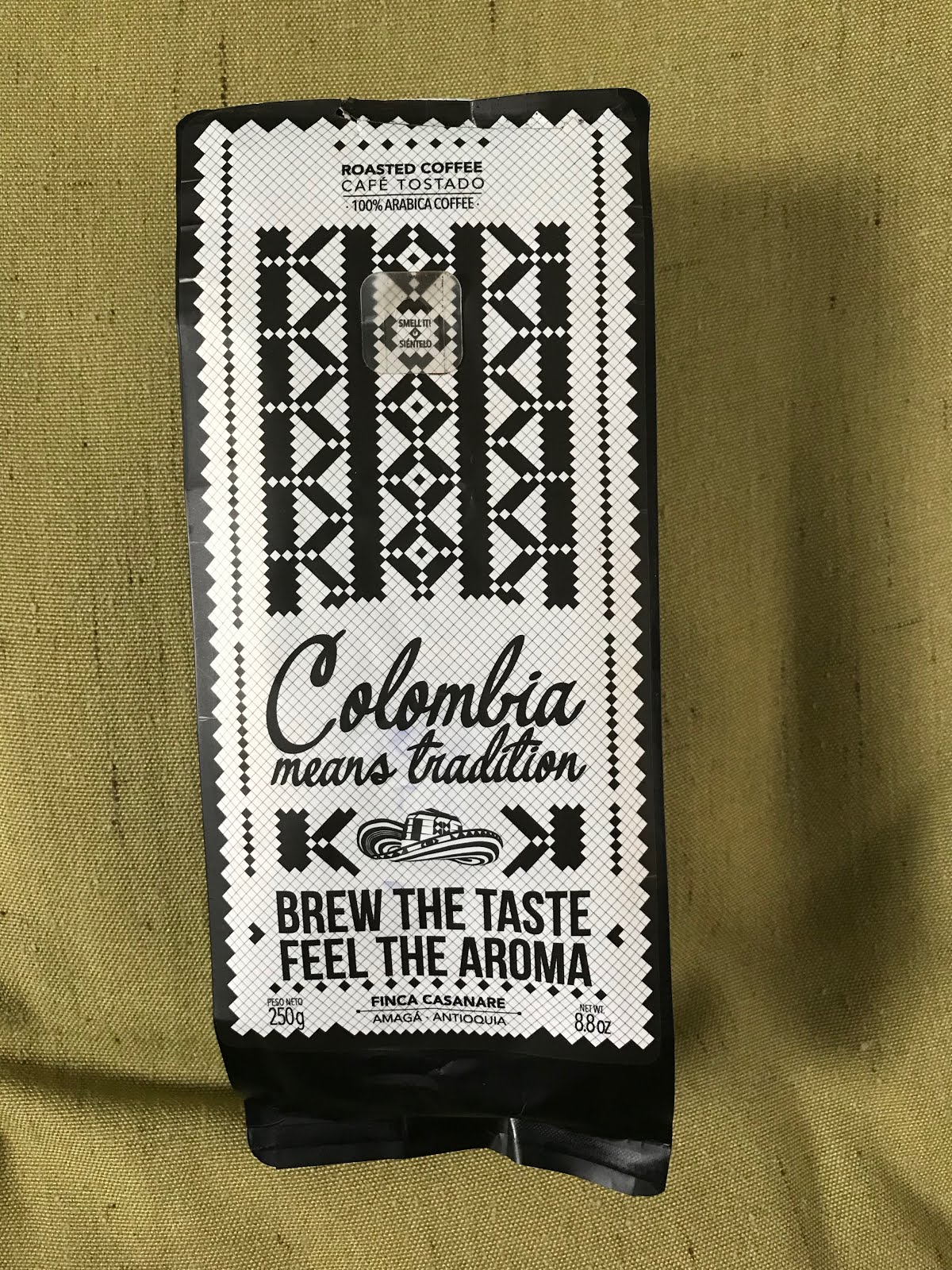
I have a friend that likes to bring me coffee from various places in Latin America that he visits. Took me about a week to drink this one up.  Tasted like a medium-dark roast, slightly bitter. Good, not great to my palette. Thoroughly enjoyed it however.

So grateful for the gifts.

2/10/19

The Beauty In Numbers, 2a: Circular Matrices


I consider myself a fledgling geometer. That is, someone who is inspired by the beauty in numbers and wants to make stuff in that realm. Geometric images and like that. Some call it Sacred Geometry. I prefer to call it Inspired Geometry. So, I'm an Inspired Geometer? Okay. I can go with that.

For many months now, I have been studying and playing with transforming numbers into pictures. I've been using a programming language called R. It is an astonishingly powerful tool. I started out being interested in using it to wrangle datasets around. I'm fascinated with big data, like many others these days. But then I discovered the expressive capacity to make art. I'm hooked. Shall I call it aRt?

Besides being free, one of the benefits of R is that if is supported the world over and contains a huge depository of libraries that people have contributed that extend the capacity of R to do all sorts of things. Many are mundane. Many are wild and wonderful.

A man named Zuguang Gu has created a huge library package call circlize that takes numeric data and creates visualizations in the circular. It is an astonishing achievement IMHO.


If you're inclined, you can learn more about it HERE. And you can learn more about R HERE.

I could get lost in this package alone for years, but I've much else to do, eh? So when I found out that I can transform a simple matrix into a circular geometric shape, I quickly fell in love with the possibilities.

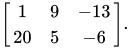
In it's simplest form, a matrix is a rectangular array of numbers arranged in rows and columns. Here is a 2 x 3 matrix of random numbers.


In R, you can create a 5 x 5 matrix consisting of the number 1 like this:
matrix(1, 5, 5)
It would look something like this:


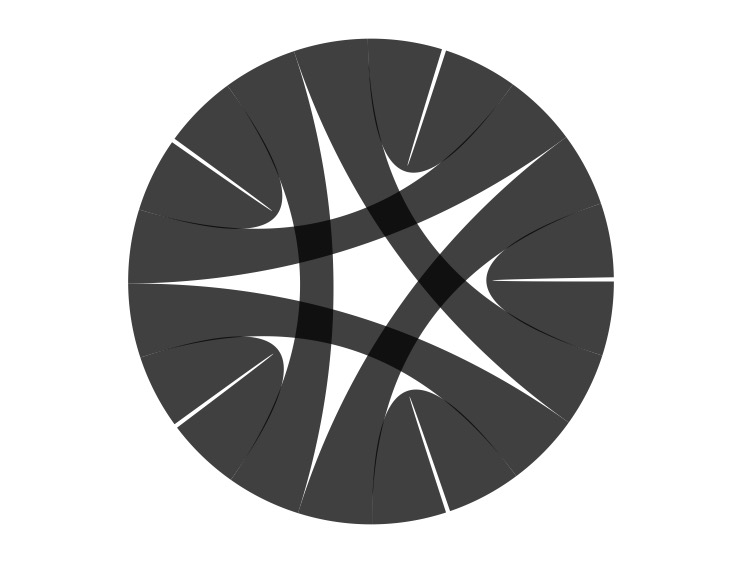
The simplest one line R program to generate a visualization of this using the circlize library, might look like:
circlize::chordDiagram(matrix(1, 5, 5))
Amazingly, this one line program generates this image:

This is because circlize appends a lot of default properties to its use. In order to get to something much simpler that I liked:


I had to add more to the program, writing this:

par(mar = c(1, 1, 1, 1), bg="white")
circlize::chordDiagram(matrix(1, 5, 5),
                       col="black",
                       symmetric = TRUE,
                       transparency = 0.25,
                       annotationTrack = NULL)

I spent weeks experimenting with colors, transparency and values to get to this point:


Next I want to transfer some of these images onto a canvas with oils.  Then, make animated movies.


1/21/19

Recent Books I've Read

Michael Finkel, Author
"It's the ending, I believe, that Knight planned. He wasn't going to leave behind a single recorded thought, not a photo, not an idea. No person would know of his experience. Nothing would ever be written about him. He would simply vanish, and no one on this teeming planet would notice. His end wouldn't create so much as a ripple on North Pond. It would have been an existence, a life, of utter perfection."


"All women are she," Mykonos once told me. "Treat each woman as the Goddess, because she is. Women are built to reveal openness--they are nature's mechanism of surrender--and they wait for a man they could trust with their utterly surrendered heart. Few women ever meet such a man, so most women suffer terribly, longing their entire lives."


"All this research proved the cancer microbe is a reality. The cell wall deficient cancer microbe is always present in cancer and its forms are varied: cocci, rods, large globoid and yeast-like forms, acid-fast granules, fungus-like forms, and giant "large body" forms. Because most physicians are taught little about cell wall deficient bacteria, the cancer microbe remains the hidden killer in cancer."

1/17/19

Midtown Delights

Hanging out at Midtown Coffee in Quincy, Ca. Rainy day. Reading, drawing, and this:


Coffee:
Ethiopian dark

Grub:
Cherry turnover

1/3/19

Found at C.A.N.

Found a can of this at C.A.N.:


It's delicious, smoky, and hot, man! I've been adding it to spice up my fixin's and I've learned to moderate it.

Chipotles are smoked jalapeno peppers. The adobo sauce usually includes the following ingredients:
cumin, paprika, coriander, fennel, yellow mustard, garlic, onion, ancho, pasilla and Mexican oregano.

In case you want to geek out on it, here's some background info on Chipotle Adobado

Chipotle, which comes from the Nahuatl word “chilpoctli” with "chil" meaning chile pepper and "poctli” meaning smoked (was originally “pochilli”). Morita means “small blackberry” in Spanish.

The ancient civilization of Teotihuacan was the largest city/ state in Mesoamerica (located north of modern day Mexico City). The original habitants of Teotihuacan smoked chiles hundreds of years before the Aztecs (1345-1521) did. This "smoke drying" process was initially used for drying meats but they found that smoking allowed the chiles to be stored for a long period of time. Teotihuacan is actually the Aztec name for the city, which translates to "Place of the Gods" as the original name has not been deciphered from surviving name glyphs (unique marks that collectively add up to the spelling of a word) at the site. Chile historians believe that the Aztecs also smoked jalapeno peppers because the fleshy, thick walls of the jalapeno were often difficult to dry in the sun and tended to rot.

Jalapeños are named after the town of Xalapa (often spelled as Jalapa) in Véracruz State (although no longer commercially grown there), and are also known by the names cuaresmeños, gordo or Lenten chiles. In Veracruz jalapenos are called “chiles gordos”, in Puebla and Oaxaca they're are called “huachinangos”. In its dried form, the traditional chipotle chile (known as chipotle “meco”) is a dull tan to deep coffee brown in color with a wrinkled, ridged surface. It is usually 2” to 4” long and 1” wide, with a medium thick flesh.

A Spanish friar living in Mexico in the 1500s wrote of a dish he ate in Cholula (modern day Puebla) called "teatzin" which had a sauce made from chipotle and pasilla chiles that was used to stew Lenten palm flowers and fresh jalapeno chiles.

After the fall of the Aztec Empire (1345-1521), smoked chiles were found mostly in central and southern Mexico markets of Chiapas, Oaxaca, Puebla and Veracruz.
(from spicesinc.com)