Showing posts with label Beauty. Show all posts

7/11/23

Hello, Blob. (A Brief Encounter With Abstract Life)


Out in some math-born corner of the void, the Blobs float.


They spin. Pulse. Change color like they’re listening to music only they can hear.


Once in a while, a presence enters their realm. A viewer. A traveler. You.


The Blobs notice. They shimmer, respond.


They spin brighter, move with more purpose, like they’re dancing just for you.


This little animation started as a whim. I wrote it in Python with Processing. Just a way to make something move, something abstract.


But once the Blobs showed up, they didn’t want to leave.


And if you watch long enough, you might feel them watching back.


11/8/22

I Guess It's Not Summer Anymore


Outside my front door.

I guess it's not summer anymore. The once-endless days of sunshine and warmth have given way to a cool, crisp breeze and the changing colors of the leaves. The air is filled with the aroma of burning wood and the distant sound of geese flying south.

Gone are the lazy afternoons spent lounging by the pool and the sound of ice clinking in glasses. In their place are cozy sweaters and hot cups of tea, enjoyed in front of a crackling fireplace. The world begins to hunker down for the long winter ahead, drawing in and slowing its pace.

As the days grow shorter and the nights longer, the world prepares to slumber once more. The trees shed their leaves in a riot of gold and red, the flowers close their petals, and the world grows quiet.

It is a time of contemplation and introspection, a time to gather in the warmth and comfort of loved ones. So let us bid farewell to summer, for it is time to turn our faces to the cool and stillness of the coming autumn, and then the snows of winter.

(Text by ChatGTP,  photo by me.)

7/2/19

Boxed In: a look at recursion

"To understand recursion, you must understand recursion."

(How I love this.)

I made one of my little generative art animations with the idea of seeing what kind of effect I could get from recursively drawing some simple shape or shapes over and over again with small changes. 

I used just a box and a circle and came up with this:


While coding, this happens when a function being defined is applied within it's own definition, like this:
function makeBox(x,y,s)
  {
    translate(x,y);
    rotate(s/10+(col/2)%360);
    blah, blah, blah
      {
         makeBox(x+s/4, y, s/2);
         makeBox(x-s/4, y, s/2);
         makeBox(x, y+s/4, s/2);
      }
  }
In this case the function makeBox calls itself within it's own definition. This can be very powerful. And so much fun!

I hope you enjoy.

6/13/19

Latest Images

This:
and this:


based on this:

I started with the above image I generated as a part of my first foray into mandalas. The top image takes the lower one as a reference and generates random points of various sizes, sampling the reference image's color. Same for the middle image, except it paints with short strokes instead of points.

4/12/19

Latest image

The latest image from my generative art series was a nice surprise.

It started as this:
for (i in 1:500)
{
x = x*((0.98)^i)*cos(i)
y = y*((0.98)^i)*sin(i)
}

which is simple R code that generates 500 x, y points that spiral. That code gave me this:


Next, I replaced the dots with line segments. This looks much different.

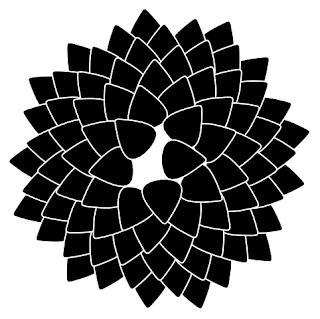
Finally, I ran an image processing script over it. The short version is that the script connects dots with a series of lines. That script spit this image out, which I love:


There are a lot of possible permutations of this I want to explore later. Like:

2/10/19

The Beauty In Numbers, 2a: Circular Matrices


I consider myself a fledgling geometer. That is, someone who is inspired by the beauty in numbers and wants to make stuff in that realm. Geometric images and like that. Some call it Sacred Geometry. I prefer to call it Inspired Geometry. So, I'm an Inspired Geometer? Okay. I can go with that.

For many months now, I have been studying and playing with transforming numbers into pictures. I've been using a programming language called R. It is an astonishingly powerful tool. I started out being interested in using it to wrangle datasets around. I'm fascinated with big data, like many others these days. But then I discovered the expressive capacity to make art. I'm hooked. Shall I call it aRt?

Besides being free, one of the benefits of R is that if is supported the world over and contains a huge depository of libraries that people have contributed that extend the capacity of R to do all sorts of things. Many are mundane. Many are wild and wonderful.

A man named Zuguang Gu has created a huge library package call circlize that takes numeric data and creates visualizations in the circular. It is an astonishing achievement IMHO.


If you're inclined, you can learn more about it HERE. And you can learn more about R HERE.

I could get lost in this package alone for years, but I've much else to do, eh? So when I found out that I can transform a simple matrix into a circular geometric shape, I quickly fell in love with the possibilities.

In it's simplest form, a matrix is a rectangular array of numbers arranged in rows and columns. Here is a 2 x 3 matrix of random numbers.
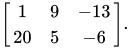


In R, you can create a 5 x 5 matrix consisting of the number 1 like this:
matrix(1, 5, 5)
It would look something like this:


The simplest one line R program to generate a visualization of this using the circlize library, might look like:
circlize::chordDiagram(matrix(1, 5, 5))
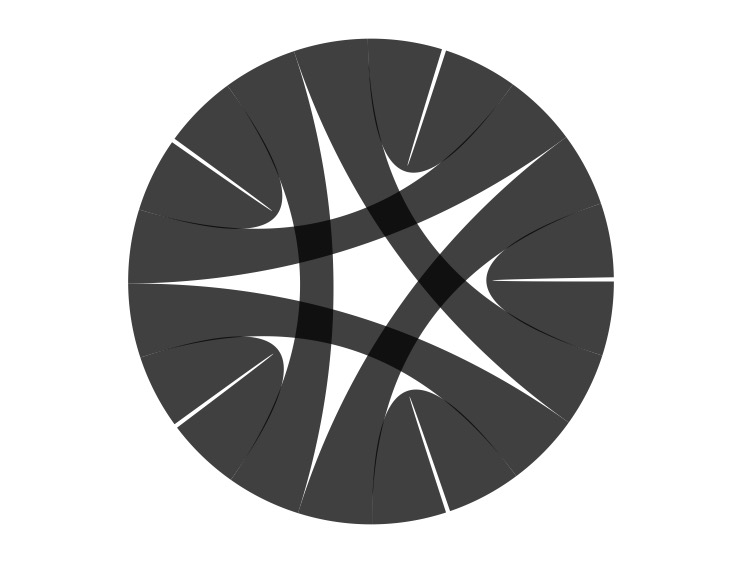
Amazingly, this one line program generates this image:

This is because circlize appends a lot of default properties to its use. In order to get to something much simpler that I liked:


I had to add more to the program, writing this:

par(mar = c(1, 1, 1, 1), bg="white")
circlize::chordDiagram(matrix(1, 5, 5),
                       col="black",
                       symmetric = TRUE,
                       transparency = 0.25,
                       annotationTrack = NULL)

I spent weeks experimenting with colors, transparency and values to get to this point:


Next I want to transfer some of these images onto a canvas with oils.  Then, make animated movies.


12/15/18

Oh, James, how I miss you. We need you now, more than ever.


I can't very easily put to words my regard for this man. I'm still reading, discovering, exalting in, and being astonished by his work. I'll let some of the words of others that have experienced his thoughts live here:
His examination of the heart image clears away constricting notions: heart as muscle and pump, as symbol of royal pride and willful energy, as seat of personal feelings.  Freed of these mechanical and personalized  notions, the heart can reclaim its place as organ of aesthetic perception that responds directly to the beauty of the sensuous world, much like the instinctual responses of animals.  Therefore, to restore the heart's courage and its imaginative power, the soul of the world needs the same attention that we have been giving to the soul of persons. For the soul cannot be owned only by humans. There is a soul quality to all things in the environment, whether "natural" or "manmade". 
And here is an obituary from the Guardian, written by Mark Kidel, 12/21/2011.
He was a dedicated subversive – witty and original – and an heir to the Jungian tradition, which he reimagined with unceasing brilliance. Fiercely critical of America's dedication to the pursuit of happiness, Hillman focused on the darkest and most difficult human experiences – illness, depression, failure and suicide – not merely as abnormal pathologies that should be avoided or cured. 
He drew on the writers and philosophers of the Italian Renaissance and ancient Greece, as well as a romantic tradition that included Keats, Goethe, Schelling and Dilthey. Not wishing to create a school of his own, he proposed an "archetypal" or "imaginal" psychology that would restore the psyche or soul to a discipline he believed to have been diminished by scientific and medical models. Influenced by the French Islamist and Sufi Henry Corbin, the poetics of Gaston Bachelard and the phenomenology of Maurice Merleau-Ponty, he argued that reality is a construct of the imagination – the stuff of myths, dreams, fantasies and images. There was, however, very little about his thought that was divorced from the world of money, war and politics. His unrelenting cultural critique embraced everything from masturbation to plastic surgery, and the design of ceilings to US foreign policy.
The "image" as an expression of the imagination, in poetry, dreams or visual art, was of paramount importance to him – as an antidote to the literalism that dominates everyday discourse. Hillman warned against the reductive tendencies of interpretation and theoretical speculation. He would advocate "sticking to the image", whose often indistinct or paradoxical language spoke, he argued, with more authenticity than verbal discourse. Film was an ideal vehicle for his ideas. He was the main contributor to my films The Heart Has Reasons (Channel 4, 1993), Kind of Blue (Channel 4, 1994) and the five part-series The Architecture of the Imagination (BBC2, 1994). 
Hillman drew on pre-Christian modes of thought – a polytheistic perspective reflecting the myriad possibilities of the human psyche, imagined as gods and goddesses, myths and metaphors whose polymorphous nature spoke for the instincts that shape our thoughts and actions more truthfully than the good-and-evil world of oppositions central to the monotheistic religions of the book.
Having practised as an analyst for 40 years, he eventually became highly critical of therapy. He argued that the sickness of humanity lay in the world rather than within each person. Therapy should, he believed, change politics, cities, buildings, schools and our relationship with the natural environment rather than focus solely on people's inner lives. 
He moved on to find a wider audience through a series of popular but still provocative books, including The Soul's Code (1997), which reached No 1 on the New York Times bestseller list, and The Force of Character (1999), works which explored, with examples running from Picasso to Hitler, the idea that we all have a calling, an individual and innate character which shapes our lives. In A Terrible Love of War (2004), he reflected on humanity's abiding martial ardour and need for the periodic spilling of blood, at great cost and with incalculable suffering. 
As well as writing beautifully – texts of layered intellectual exposition that were dense yet always skilfully articulated – Hillman was an electrifying lecturer and teacher: a tall and charismatic mixture of rabbinical scholar and comedian, with a breathtaking ability to lead his audience through arguments that turned accepted ideas upside down. Unlike other critics of the mainstream approach to mental illness, he was not "anti" anything, seeing in opposition a fantasy that drew us away from meaning and from life. He preferred to deconstruct, often playfully, whether he was speaking of plastic surgery, the politics of the Middle East or the paranoia of the psychiatric profession.
James Hillman, 1926-2011.  A hero in my world. If you can only read one of his books, get THE SOUL'S CODE.

12/1/18

PASSING AN ORCHARD BY TRAIN


Grass high under apple trees,
The bark of the trees rough and sexual,
the grass growing heavy and uneven.

We cannot bear disaster, like
the rocks--
swaying nakedly
in open fields.

One slight bruise and we die!
I know no one on this train.
A man comes walking down the aisle.
I want to tell him
that I forgive him
that I forgive him, that I want him
to forgive me.

ROBERT BLY

11/23/18

ARCHAIC TORSO OF APOLLO


We cannot know his legendary head
wide eyes like ripening fruit. And yet his torso
is still suffused with brilliance from inside,
like a lamp, in which his gaze, now turned to low,

gleams in all its power. Otherwise
the curved breast could not dazzle you so, nor could
a smile run through the placid hips and thighs
to that dark center where procreation flared.

Otherwise this stone would seem defaced
beneath the translucent cascade of the shoulders
and would not glisten like a wild beast's fur:

would not, from all the borders of itself,
burst like a star: for here there is no place
that does not see you. You must change your life.

RAINER MARIA RILKE

11/1/18

The Beauty In Numbers, 1b: A circle, a spiral, a flower.


A curve that starts from a point and moves farther away as it revolves around the point is called a spiral.


These happen everywhere in nature.  Spiral curves are seen in the way plants arrange their leaves in circular patterns. It turns out, rather beautifully, that these plant spirals are often formed according to something called the Golden Angle, which in turn, is related to the Golden Ratio, also seen in the Fibonacci series. I won't go into the Golden Ratio here( dude, look it up! ), but the Golden Angle seen below as angle b can be thought of this way: the ratio of the arc of b to a is the same as the ratio of a to the entire circle.


Another way to calculate it: Golden Angle = Ï€(3 − √5) = roughly 2.4 radians = roughly 137.5 degrees.

Now, if we plot 500 points, plugging in the Golden Angle in R, the code would look like this:

# Defining the number of points
points = 500

# Defining the Golden Angle
angle = pi*(3-sqrt(5))

t = (1:points) * angle
x = sin(t)
y = cos(t)
df = data.frame(t, x, y)


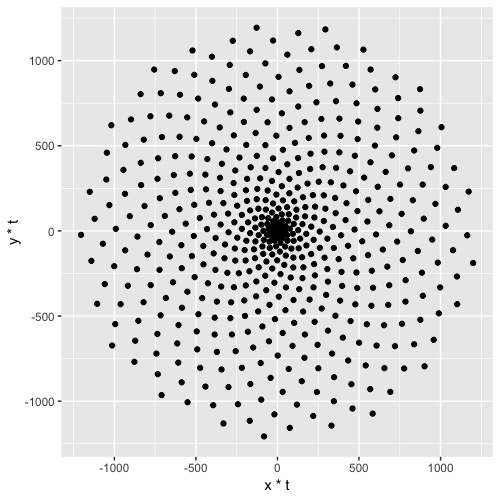
resulting in


and if we clean it up and add some color, we get


Cool. I LOVE this!

10/3/18

The Beauty In Numbers, 1a: Plotting a circle.


Let's use math to draw pictures, shall we? There is a wonderful world out there of representing patterns in nature, especially flowers, in mathematical terms. Ever gazed into a sunflower? I hope so. I'm learning and exploring as I go along here, so I'll start with simple circle plots and move on from there. But where to start?  How about Pythagorus?

Although it is often argued that knowledge of the theorem predates him, the theorem is named after the ancient Greek mathematician Pythagoras (c. 570–495 BC) as it is he who, by tradition, is credited with its first proof, although no evidence of it exists. There is some evidence that Babylonian mathematicians understood the formula, although little of it indicates an application within a mathematical framework. Mesopotamian, Indian and Chinese mathematicians all discovered the theorem independently and, in some cases, provided proofs for special cases. (Wikipedia)

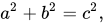
The Pythagorean theorem is a wondrous thing, having to do with the relationship among the three sides of a right triangle. The theorem states that the square of the hypotenuse (the side opposite the right angle) is equal to the sum of the squares of the other two sides. It can be written as an equation relating the lengths of the sides a, b and c, :

where c represents the length of the hypotenuse and a and b the lengths of the triangle's other two sides.

But how do we turn this into compelling pictures? We can do a lot with this if we use software programs to draw or plot, say, circles. A lot of beautiful geometric patterns come out of circles, including patterns that represent the arrangement of petals and stems in flowers. But how do we get circles out of these triangles? By expressing the Pythagorean theorem in terms of trigonometric functions.


We need to move to trigonometry because we need to move beyond solving triangles. Trigonometry give use a mathematical description of our physical world, of things that rotate or vibrate, such as light, sound, the paths of planets about the sun or satellites about the earth. We have to have angles of any size, and to extend to them the meanings of the trigonometric functions.


The Pythagorean trigonometric identity states that sin²(θ) + cos²(θ) = 1 for any real number θ. Since every (x, y) point should be in the unit circle (a circle with a radius of 1), it follows that x² + y² = 1.

Okay. Now that we've established the background information, we can begin building a series of plots. We start by creating a dataset of two variables, x and y. First, we'll draw 50 points on a circle of radius 1. 

In R, some code for drawing (plotting) 50 points in a circle looks like this:

t = seq(0, 2*pi, length.out=50)
x = sin(t)
y = cos(t)
df = data.frame(t, x, y)

# Make a scatter plot of points in a circle
ggplot(df)

Running this code results in this:


Very basic, yes? But with various enhancements and tweaks to the code, we can begin to get images that look like the geometry seen in flowers.

Thanks to @aschinchon

10/1/18

Hello, you gorgeous algorithm you.

Can there be beauty in math?  I think so. I want to experiment with this idea for awhile. So, here goes a new series: The Beauty In Numbers. I'm going to off on a tangent (!) and study mathematics and art together.
Algorithmic Beauty in Plants

Mathematics, rightly viewed, possesses not only truth, but supreme beauty—a beauty cold and austere, like that of sculpture, without appeal to any part of our weaker nature, without the gorgeous trappings of painting or music, yet sublimely pure, and capable of a stern perfection such as only the greatest art can show. The true spirit of delight, the exaltation, the sense of being more than Man, which is the touchstone of the highest excellence, is to be found in mathematics as surely as poetry. (Bertrand Russel)

Why are numbers beautiful? It's like asking why is Beethoven's Ninth Symphony beautiful. If you don't see why, someone can't tell you. I know numbers are beautiful. If they aren't beautiful, nothing is. (Paul ErdÅ‘s)

9/20/18

World as lover, world as self.


"... it's Ok for our hearts to be broken over the world. What else is a heart for? There's a great intelligence there. We've been treating the earth as if it were a supply house and a sewer. We've been grabbing, extracting resources from it for our cars and our hair dryers and our bombs, and we've been pouring the waste into it until it's overflowing, but our earth is not a supply house and a sewer. It is our larger body. We breathe it. We taste it. We are it, and it is time now that we venerate that incredible flowering of life that takes every aspect of our physicality."

Joanna Macy

8/29/18

I Feel More And More Every Day,


as my imagination strengthens, that I do not live in this world alone but in a thousand worlds. (John Keats)

I have had the great pleasure of making art as a collaboration with a lovely young woman who lives not far from me. She is an amazing and beautiful person, an aerial silks artist and circus performer, among other things.

Together we have performed locally, she on the silks and me watching her and playing accordion extemporaneously, trying to match her gestures with music.

This makes me so happy. I live for these kind of experiences.

Thank you Chelsea.

8/26/18

Work?


Work?
I don't have to work.
I don't have to do nothing
but eat, drink, stay black, and die.
This little old furnished room's
so small I can't whip a cat
with out getting fur in my mouth
and my landlady's so old
her features is all run together
and God knows she sure can overcharge--
Which is why I reckon I does
have to work after all.

LANGSTON HUGHES

8/11/18

Beauty. The Invisible Embrace.


Yet beauty's visitation affects us and invites us into its rhythm, it calls us to feel think and act beautifully in the world: to create and live a life that awakens the Beautiful. A life without delight is only half a life. Lest this be construed as a plea for decadence or a self-indulgence that is blind to the horrors of the world, we should remember that beauty does not restrict its visitations only to those whom fortune or circumstances favour. Indeed, it is often the whispers and glimpses of beauty which enable people to endure on desperate frontiers.

This book by John O'Donohue, with the above title, has become my bible. This man has said everything in this one book that I couldn't express in a lifetime.

In Greek the word for 'the beautiful' is to kalon. It is related to the word kalein which includes the notion of 'call'. When we experience beauty, we feel called. The Beautiful stirs passion and urgency in us and calls us forth from aloneness into the warmth and wonder of an eternal embrace. It unites us again with the neglected and forgotten grandeur of life. The call of beauty is not a cold call into the dark or the unknown; in some instinctive way we know that beauty is no stranger. We respond with joy to the call of beauty because in an instant it can awaken under the layers of the heart a forgotten brightness. Plato said: 'Beauty was ours in all its brightness ... Whole were we who celebrated that festival' (Phaedrus).


8/3/18

Innocent Villagers


We, too, cry falling to the edge of
the earth. But we don't store our voices
in old jars. Nor hang mountain goats
on the wall. Nor claim the kingdom of dust
Nor do our dreams look out over the grapes of others
Nor do they break the rule.

Mahmoud Darwish

7/15/18

What Is Music?


We know that sound results from the vibrations of air molecules moving through the air to our eardrums, that the speed of those vibrations is referred to as frequency, measured in Hertz, and that pitch is the relative highness or lowness of a sound. But what is music?

I love this quote by T Bone Burnett, who I admire in spades. It’s a beautiful and elemental way to think about music.


“I view all instruments as drums and all music-making as tribal. A violin is just a drum with some strings attached, but it’s still a resonating chamber you attack with a bow or your fingers. A flute is a drum with holes in it that you blow through to make different pitches with that resonating chamber you attack with your breath. A band is, ‘Okay, we’re a tribe now. We’re going to be in this village right now and we’re going to tell people in the next village what’s happening over here.’ That’s all it is, really.”

6/28/18

Church Modes (DPL - MAL)


Learning the names of the modes (why are they sometimes called the church modes?).

So weird.

Making a smart flashcard deck. DPLMAL is a mnemonic.

6/18/18

Project #8 (Part One): Scales on guitar


Again, weird that I haven't learned this by now. So, here we go. First I want to learn the Pentatonic Scales all over the neck.

7/14/18
Another long term project! Rather than pentatonic, I'm thinking of learning the major scale first, reasoning that all other scales can be derived from it. So many different approaches CAGED, 3 notes per string, etc.